

Updated on: October 27, 2026
An HVAC capacitor is a small, can-shaped electrical part inside your outdoor AC unit or heat pump. It stores energy and releases it in a burst to start the compressor and fan motors, then helps keep them running smoothly. On a hot afternoon, a failed one can be the reason the outdoor unit hums, the fan never spins and the vents blow lukewarm air. The signs below tell you when to call an emergency HVAC technician and what to tell them.
Key takeaway
A failing capacitor is one of the most common reasons an air conditioner or heat pump stops starting. On its own, it is usually a small, low-cost repair. Running the system on a bad capacitor can burn out the far more expensive compressor or fan motor. Switch the system off and have a technician test and replace the capacitor. Never handle it yourself, because it holds a dangerous charge even with the power off.
Who this guide is for
This guide is for Worcester County homeowners whose AC or heat pump hums, won’t start or blows warm air, and who want to know whether the capacitor is the cause and what to do next.
Related guides: How Often Should HVAC Be Serviced, How Often to Change HVAC Filter.
HVAC capacitor at a glance
- Classic sign: the outdoor unit hums, but the fan and compressor won’t start.
- Installed replacement in Worcester County usually runs $300 to $400.
- Most AC capacitors last 10 to 20 years.
- A replacement must match the old label’s type, µF and voltage.
- Heat pumps use capacitors too, so a failure can stop winter heating.
What is a capacitor in an AC unit and what does it do?
Credits: The Engineering Mindset
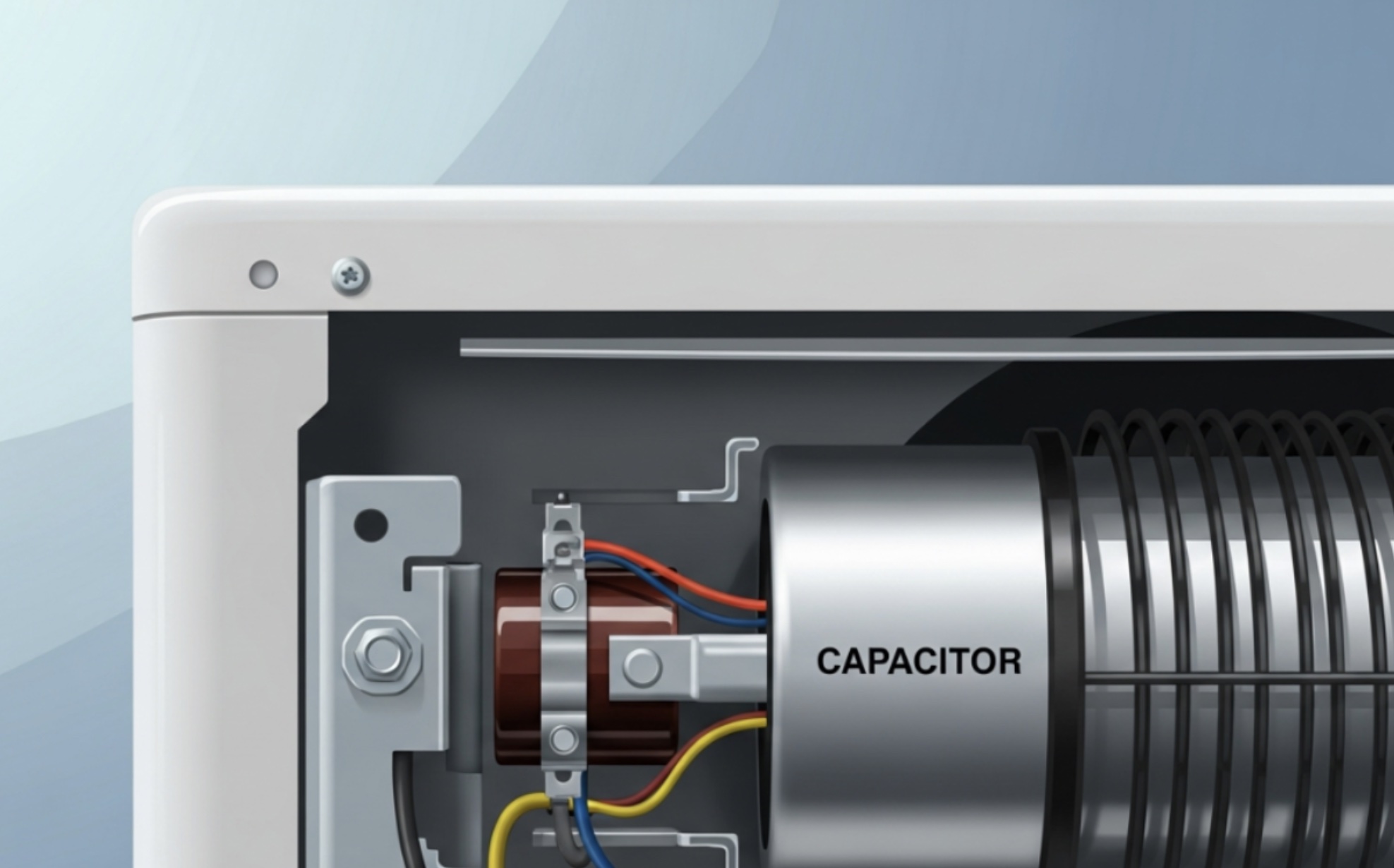
On a central air conditioner or heat pump, the capacitor sits inside the electrical panel of the outdoor unit, also called the condenser. It looks like a metal or plastic cylinder about the size of a soda can, with wires attached to terminals on top. Despite the battery-like shape, it releases its stored energy in quick bursts and does not power anything for long.
Two motors depend on it: the compressor and the outdoor fan motor. Starting a large, heavy motor like the compressor takes a sudden surge of power.
It’s the electrical equivalent of pushing a stalled car. You need a huge initial heave to get it moving. Once it’s rolling, it takes much less effort to keep it going.
Your home’s electrical wiring provides the steady “keep it going” power, but it can’t provide that initial heave on its own. The capacitor stores the energy for that heave and releases it the moment the motor needs it. After that, it keeps feeding the motors a smaller, steadying current through the cooling cycle.
Start vs. run capacitors: what sets them apart
An AC system can use more than one kind of capacitor: two separate kinds, or both in the same case.
Start capacitors
When your AC motor needs to start, a start capacitor delivers a large electrical jolt for about 1 to 2 seconds.
- What it does: The motor can’t get going on its own. This capacitor gives it the hard initial kick it needs to break free from standing still.
- How it works: Once the motor is spinning, a switch cuts the capacitor out of the circuit. It then sits idle, slowly charging back up until the system starts again.
You’ll find these in older units or bigger HVAC systems where the motor needs that extra push to get started.
Run capacitors
A run capacitor stays connected the whole time the motor is running.
- What it does: It keeps electricity flowing clean and balanced. The motor stays cool, doesn’t burn itself out and uses less energy.
- How it works: It charges and discharges continuously, keeping everything in balance the whole time.
Dual capacitors: two in one case
To save space and simplify wiring, residential air conditioners and heat pumps often use a dual capacitor: two capacitors in a single, compact case.
It has three terminals, often labeled:
- HERM (for the compressor)
- FAN (for the fan motor)
- C (for the common connection)
This one part serves both motors. It gives the compressor a start boost and smooths its run, and it stabilizes the fan motor. When a technician says you have a bad capacitor, they usually mean this dual capacitor.
How does an AC capacitor work?
Inside the can are two thin metal sheets sitting close together, with insulation between them. The whole thing is rolled up tight and sealed in the case.
Power builds up between the sheets. When the thermostat calls for cooling, the stored energy rushes out at once to shove the motor into motion.
Every capacitor label carries two ratings:
- Microfarads (µF or MFD): how much charge the part stores. A dual capacitor shows two numbers, one for the compressor and one for the fan.
- Voltage: the most the part can safely handle.
Any replacement must match the type and ratings on the old part’s label, and start and run capacitors are not interchangeable. Too little capacitance means hard starts or no start at all. Too much strains and wears out the compressor.
Signs of a bad AC capacitor
- Hum or buzz, but no start: You hear a click from the thermostat and a hum from the outdoor unit, but the compressor and fan don’t kick on. That hum is the motors receiving steady “run” power from your home without the “start” jolt from the capacitor. Left that way, they overheat.
- Outdoor fan not spinning: The unit hums, but the fan blades on top sit still.
- Fan clicking off and back on: While the unit runs, the outdoor fan stops for a second, then starts again.
- Slow starts or short cycling: The AC takes a while to start, or shuts off and restarts on its own.
- Warm or lukewarm air: A weak capacitor may still start the system but can’t keep it running right, so the cooling cycle drags on.
- Burning smell or smoke: Shut the system off and call for service immediately.
- Lights dimming or the breaker tripping: This happens when the AC kicks on and the motor draws too much current.
- Unexplained rise in summer electric bills: A struggling motor draws more current to do the same job.
- Bulging top or oily leak: A technician confirms this with the panel open. Homeowners should keep the panel closed.
An AC that runs but isn’t cooling the house, or one making new noises, can have causes other than the capacitor. A technician’s test is what confirms it.
Can an AC run without a capacitor?
An AC can’t run properly without a working capacitor. The compressor, the outdoor fan motor or both usually cannot start, or cannot keep running once they do.
A weak capacitor that hasn’t fully died may still get the unit started, but the motors then labor and run hot through every cycle.
Should you turn off your AC if the capacitor is bad?
Switch the system off at the thermostat until it is repaired.
Each failed start attempt sends power to a motor that can’t turn, which overheats the compressor and fan motor. Centerline Mechanical puts a failed-compressor repair at $1,000 to $2,000 or more for homes in the Milford and Worcester County area. National cost guides put a full out-of-warranty compressor swap higher, roughly $1,500 to $4,650 or more, depending on system size and whether the whole condenser needs replacing.
If the unit smells burnt or is smoking, also switch off the AC breaker or the outdoor disconnect.
In hot weather, close the blinds and run ceiling fans to keep the house cooler while you wait. Then call for service so a technician can test the capacitor and the motors before any more damage is done.
When to call an HVAC technician: this is not a DIY
Do not, under any circumstances, try to replace a capacitor yourself if you are not a trained professional.
The part is inexpensive and you may be handy, but a capacitor is not like a battery you pop in and out of a remote. Even with the power to the HVAC unit turned off, a capacitor can still hold a lethal electrical charge, sometimes for days, powerful enough to stop your heart. Discharging it safely takes a specific tool and specific knowledge.
When you suspect a bad capacitor, your only move is to call a licensed HVAC professional. [2]
- Safety: An HVAC technician has the training and tools to safely discharge the capacitor and handle the replacement.
- Accurate check: A professional tests the capacitor to confirm it’s the problem.
- Correct replacement: A capacitor with the wrong µF or voltage rating can destroy your compressor in short order, so a professional makes sure you get exactly the right part.
- Warranty and peace of mind: A professional capacitor replacement comes with a guarantee on both the part and the labor. A DIY job risks the compressor failure and repair bill described above.
What you can safely check before you call
Keep the access panel on the outdoor unit closed. These checks need no tools and no open panels:
- Thermostat: Make sure it is set to cool, set below room temperature, and has working batteries if it uses them.
- Power: Make sure the AC breaker and the outdoor disconnect are on. Reset a tripped breaker once only. If it trips again, stop and call.
- Listen and look: Stand near the outdoor unit, listen for humming, and look through the top grille to see whether the fan is turning.
- Smell: Note any burning smell.
- Hands off: Do not poke the fan blades with a stick or tool to get them spinning.
If the unit hums and the fan isn’t turning, call a licensed HVAC company. Tell them the unit isn’t starting, that you hear a hum, and that you suspect a bad capacitor.
For more trusted guides and expert tips on keeping your home comfortable, visit Centerline Mechanical, your go-to resource for a happy home.
How a technician tests a capacitor
A proper capacitor test follows this order:
- Power off: Power is cut at the breaker and the outdoor disconnect.
- Discharge: The capacitor is safely discharged with insulated tools.
- Inspection: It is checked for bulging, leaking oil, rust or burn marks.
- Measurement: Its capacitance is measured with a meter and compared with the µF rating on its label. A reading too far below the rating means it needs replacing.
If the capacitor fails, the technician installs a new one with matching ratings, then restores power and confirms both motors start.
A good technician also checks the contactor, fan motor and compressor. A capacitor can fail because a motor is struggling, and replacing the capacitor alone won’t fix that.
How much does AC capacitor replacement cost?
In Worcester County, Centerline Mechanical states that common repairs like replacing a capacitor usually fall in the $300 to $400 range, with parts, service call and labor included.
The part itself is a small share of that. This Old House reports capacitors typically cost $8 to $45, with run capacitors at $8 to $30 and dual run capacitors at $15 to $45. The service call and labor make up most of the bill.
What moves the price:
- Part type: a single or dual capacitor, and a brand-name or OEM part.
- Consolidation: whether the technician replaces two single capacitors with one dual.
- Access: how easy the outdoor unit is to reach and work on.
- Timing: same-day, after-hours or weekend visits during a heat wave.
- Other findings: a worn contactor or motor turned up on the same visit.
On an older system with repeated failures, it is worth asking whether to repair or replace the whole system, which costs much more depending on the equipment type and the size of your home. Call Centerline Mechanical for a quote on your system.
How long do AC capacitors last?
This Old House puts the typical life of an AC capacitor at 10 to 20 years before it fails. Following general HVAC maintenance tips for homeowners helps prevent premature wear on these components.
What shortens that life:
- Heat: summer heat and direct sun on the outdoor unit.
- Power events: surges, lightning and short circuits in the system.
- Dirt: dust and debris on the terminals.
- Wrong part: a replacement with the wrong rating.
- Wiring: loose or failing connections.
- Compressor strain: an aging, hard-starting compressor.
What extends it:
- Part quality: higher-quality parts handle heat better, so ask about part quality when one is replaced.
- Clear outdoor unit: keep shrubs, leaves and debris away from it.
- Yearly tune-up: a technician can clean the terminal connections and catch a capacitor drifting below its rating before it fails in the middle of a heat wave.
Does a heat pump have a capacitor?
A heat pump’s outdoor unit uses a capacitor the same way, to start and run its compressor and fan.
A heat pump in Worcester County runs through both the cooling and heating seasons, so its capacitor works year-round. A failure can stop heating too, with the same hum-but-no-start signs in winter. If your system has backup heat, it may keep the house warm for a while, but schedule the repair promptly. The main difference between a heat pump and an air conditioner is that a heat pump also heats, by reversing the same cycle.
Frequently asked questions
How many capacitors does an HVAC system have?
Most central AC and heat pump outdoor units have either one dual capacitor serving the compressor and fan or two single capacitors, and some add a start capacitor or hard start kit. Furnaces and air handlers with older-style blower motors can have their own run capacitor indoors, so a no-airflow problem inside the house can also be a capacitor.
Can I buy my own capacitor and have a technician install it?
Capacitors are sold online and at supply houses, and many technicians carry common sizes on the truck, but some contractors won’t install customer-supplied parts or won’t warranty them. Because the part is a small share of the installed price, buying it yourself saves little.
Is a capacitor covered by my AC warranty?
It may be, if the equipment is still within its manufacturer parts warranty. Check your registration paperwork or ask your installer, since labor coverage is usually separate. Some capacitor brands carry their own part warranty, and replacing it yourself or using the wrong part can void that coverage.
What is a hard start kit, and does my AC need one?
A hard start kit adds a larger start capacitor and a relay that give an older or struggling compressor extra help starting, but it adds parts that can fail and can hide a failing compressor. Ask your technician whether your compressor is hard-starting before adding one.