

If you’re asking “why is my AC not cooling my house,” it’s usually something basic: restricted airflow, a thermostat setting issue, or an outdoor unit that can’t breathe. Those are often safe to check yourself.
Sometimes it’s bigger: a frozen coil, low refrigerant from a leak, or a failing component. That’s when you stop troubleshooting and call a licensed technician. Use the steps below to go from guessing to a clear next move.
Key Takeaways
- Start with airflow and thermostat settings. Most “no cooling” calls live there.
- If you see ice or hear hissing, shut the system down and call a pro.
- Outdoor airflow matters. A clogged condenser can make the whole system fall behind.
Step 1: Confirm Airflow Before You Assume the Worst
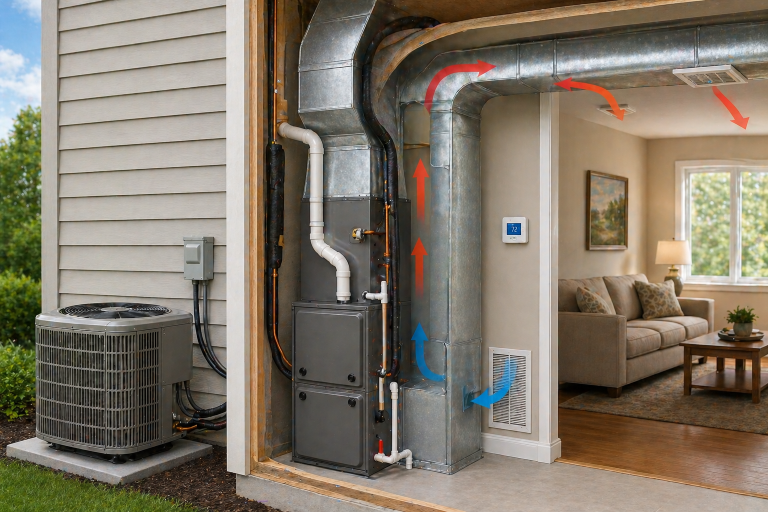
When the AC is running but the air feels warm, it’s easy to jump to worst-case scenarios. But an air conditioner is basically an air mover. It pulls warm air in, cools it, and sends it back out. If airflow is restricted anywhere in that loop, cooling falls apart fast.
Start with the return grille. That’s the larger grille (often in a hallway) that pulls air into the system. If it’s blocked by furniture, curtains, or storage, the system can’t “breathe” properly.
Then check the supply vents. Make sure they’re open and not covered by rugs, bedding, or furniture. Closing vents to “save money” often backfires because it increases pressure and reduces overall airflow.
Step 2: Check the Air Filter (Small Part, Big Consequences)
Next, check the filter. You’ll usually find it in the return grille or in a slot near the furnace/air handler.
If it’s packed with dust and hair, your system has to work much harder to pull air through. That restriction can also trigger a bigger problem: the indoor coil gets too cold, moisture freezes on it, and airflow drops even more as ice builds.
If you replace the filter and airflow improves, you may have solved the main problem right there.
Step 3: What to Do If You Suspect a Frozen Coil
If airflow is weak and you suspect ice, don’t force it.
Turn the thermostat from Cool to Off. Then set the fan to On. That keeps air moving across the coil and helps it thaw.
Give it time. Thawing can take a few hours, and sometimes longer if the coil is heavily iced. Don’t scrape ice off the lines or coil. That’s an easy way to puncture something expensive.
Once it’s fully thawed and the filter is clean, switch back to Cool and see if the system recovers. If it freezes again, you likely have an airflow problem deeper than the filter, or a refrigerant issue.
Step 4: Check the Outdoor Unit (The Other Half of Cooling)
Your AC is a split system. The indoor side absorbs heat. The outdoor side has to dump that heat outside. If the outdoor unit can’t breathe, the system struggles like it’s trying to exhale through a blocked airway.
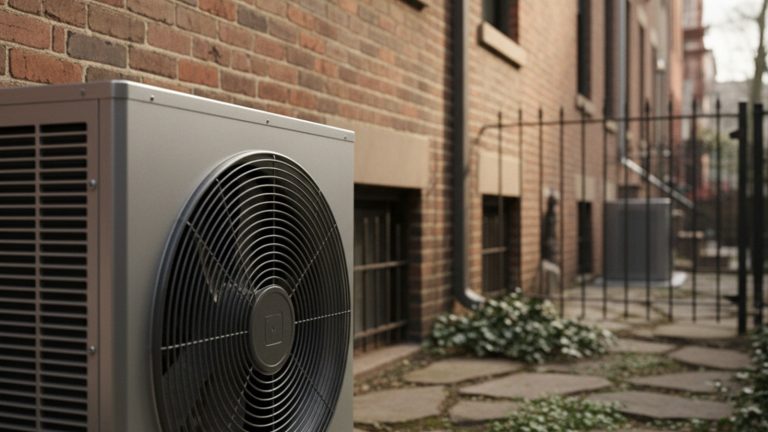
Go outside and look at the condenser (the metal cabinet with a fan on top). You want open space around it. Trim back plants and clear leaves or debris that can trap heat inside the coil.
If the coil fins are visibly clogged with dirt or fuzz, that can reduce heat release and slow cooling. If you’re comfortable doing so, shut power off at the disconnect and gently rinse the coil with a garden hose. Don’t use a pressure washer. Bent fins make the problem worse.
Step 5: Thermostat and Power Checks That Actually Matter
Sometimes the system isn’t broken. It’s just being told the wrong thing.
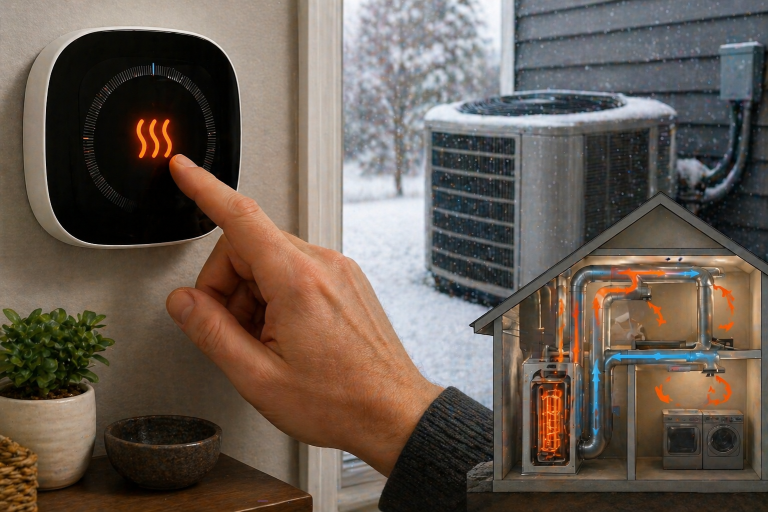
Make sure the thermostat is set to Cool and the set temperature is lower than the room temperature. If your thermostat has batteries and the display is acting weird or blank, replace them.
Check the fan setting. Fan: On can make it feel like warm air is “blowing” constantly even when the system isn’t actively cooling. Fan: Auto is usually the right choice for normal cooling.
If nothing seems to start outside, check the breaker labeled AC/HVAC. If it tripped, flip it fully off, then back on. Also check the disconnect box near the outdoor unit to make sure it’s on.
One more common issue: a clogged condensate drain can trigger a safety shutoff. If you see water around the indoor unit or a full drain pan, shut the system off and call a pro. Ignoring it can lead to water damage.
When to Suspect Refrigerant Problems
Refrigerant carries heat out of your home. The system is sealed, so it shouldn’t “run low” under normal conditions. If refrigerant is low, it usually means there’s a leak.
This is not a DIY fix. Refrigerant work requires specialized tools and licensing.
Common signs include a soft hissing sound, ice on the larger copper line, cooling that feels weak even with good airflow, and a system that runs constantly without reaching the set temperature.
If you see ice or hear hissing, shut the system off. Running low can overheat and damage the compressor, which is one of the most expensive parts.
What You Can Fix vs What Needs a Pro
Most safe DIY work is airflow and light exterior cleaning. If troubleshooting starts drifting toward electrical panels or sealed-system components, stop.
DIY-safe checks (high impact)
- Replace the air filter.
- Make sure returns and vents are open and unblocked.
- Clear debris and give the outdoor unit space.
- Gently rinse the outdoor coil with power off (if you’re comfortable).
- Confirm thermostat mode, setpoint, and fan setting.
Call a pro if you see any of this
- Ice that returns after thawing.
- Hissing, bubbling, or suspected refrigerant issues.
- Outdoor fan not spinning while the system is calling for cooling.
- Burning smell, loud grinding/screeching/banging.
- Breaker trips again immediately after resetting.
- Water leaking around the indoor unit beyond normal condensate drainage.
Quick Reference Checklist
If you want the fastest possible sequence, do this in order:
- Thermostat on Cool, fan on Auto, setpoint below room temp.
- Check filter. Replace if dirty.
- Check return grille and vents for blockages.
- Look for ice. If iced: Cool Off, Fan On, wait to thaw.
- Clear space around the outdoor unit and check the coil condition.
- If symptoms persist or you see ice/hissing/burning smells: call a professional.
FAQ
Why is my AC not cooling my house even though it’s running?
Most often it’s airflow. A dirty filter, blocked return, closed vents, or a frozen coil can make the system run without moving enough air to cool your home. If airflow looks normal but the air never gets cold, suspect refrigerant problems or an outdoor-unit failure.
What’s the first thing I should check?
Check the filter, then check the return grille and vents. Airflow problems are the most common and the fastest to fix.
What does it mean if my AC is blowing warm air?
Warm air usually points to one of three things: the outdoor unit isn’t rejecting heat properly, the indoor coil is frozen, or the system has a refrigerant issue. If the outdoor fan isn’t spinning or you see ice on the lines, shut it down and call a pro.
Is ice on the refrigerant line a big deal?
Yes. Ice usually means low airflow or low refrigerant. Thaw it first (Cool Off, Fan On). If it returns, it’s time for service.
Can my AC “run low” on refrigerant over time?
Not normally. It’s a sealed system. If it’s low, there’s usually a leak.
Why does my thermostat look right but the house still won’t cool?
Make sure the fan isn’t set to On, check for schedule overrides on smart thermostats, and confirm the outdoor unit is actually starting. If the outdoor unit never comes on, you may have a power or control problem.
What if the breaker keeps tripping?
Reset it once. If it trips again, stop and call a technician. Repeated trips can signal a serious electrical or compressor issue.
When should I stop troubleshooting and call someone?
If you hear hissing, smell burning, see ice that returns after thawing, the outdoor fan isn’t spinning, or the system won’t cool after airflow checks, it’s time.
Preventing the Problem Next Time
Most cooling failures don’t come out of nowhere. Change your filter regularly, keep the outdoor unit clear, and schedule a spring checkup so small issues don’t show up on the first heat wave.
If basic checks don’t restore cooling, homeowners in Central Massachusetts can contact Centerline Mechanical for a clear diagnosis and reliable comfort restoration.