
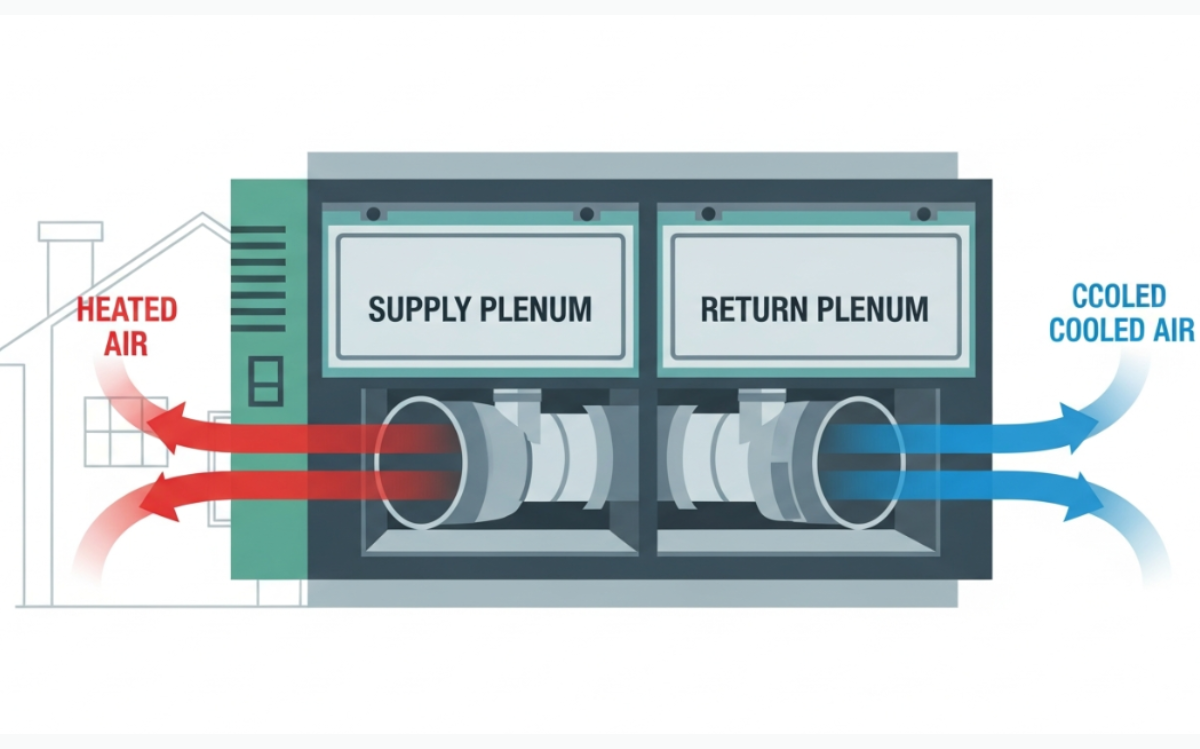
Let me start with a scene that might feel a little too familiar.
You walk into the living room and it’s comfortable, perfectly cooled by your central air system. But then you head down the hallway, open the bedroom door, and boom: it’s stuffy.
A few degrees warmer. Maybe even humid. You glance at the thermostat thinking, “How can one HVAC system deliver two totally different climates in the same house?”
Here’s the thing most homeowners don’t realize:
It’s not always the air conditioner, the duct design, or even the insulation.
Quite often, the real troublemaker is something you rarely see, never think about, and probably weren’t told exists unless an HVAC contractor pointed at a sheet-metal box and said, “Yeah, that’s your plenum.”
And because it’s invisible, it’s usually ignored, until comfort problems, airflow issues, or even air quality complaints start piling up.
That’s why understanding the plenum in HVAC systems isn’t trivia. It’s the quiet, overlooked detail that decides whether the heated or cooled air your system works so hard to produce actually reaches the rooms where your family spends their time.
The plenum is the “hub,” the “junction box,” the “traffic director,” the piece of HVAC equipment that directly controls air distribution, airflow pressure, and indoor comfort.
And if you get this one part wrong, whether during plenum installation, duct modifications, or unit replacement, you can sabotage even the best heating and cooling system.
So let’s break it down. Simply. Practically. And with the urgency this overlooked component deserves.
Defining HVAC Plenums and Their Function
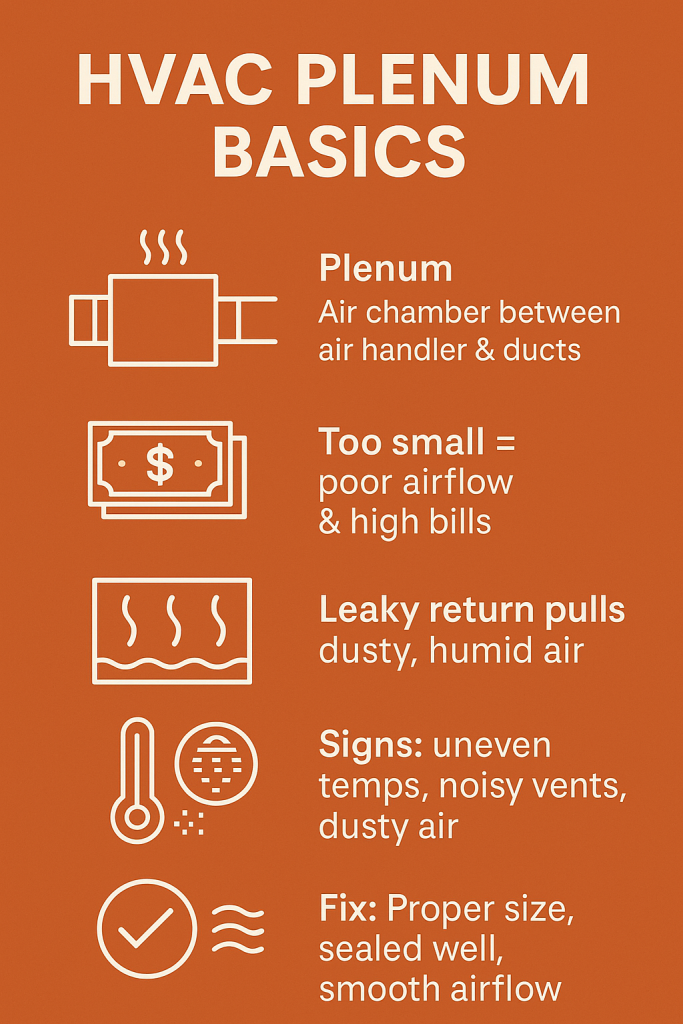
Most people imagine an HVAC system as two things: the big metal air handling unit and the air ducts spidering off from it. But between those two sits something essential: the plenum box. [1]
Picture it like this:
Your air handling unit (the furnace or air handler) produces conditioned air, heated air in winter, cooled air in summer. But it doesn’t immediately blast that air straight into every duct branch. It first sends it into a chamber, the plenum, a kind of gathering space.
An HVAC plenum is:
- A box or chamber (usually made of sheet metal or insulated fiberglass board).
- Installed right beside or attached to the air handling unit.
- The spot where all the air from your system gathers before it heads into the ducts.
- A pressure-controlled zone that makes airflow smooth, stable, and evenly distributed.
Think of it like a roundabout in a neighborhood. Instead of traffic shooting in all directions chaotically, every route flows from one organized point. The plenum prevents chaos in your airflow system.
Why does this matter?
Because without a properly installed plenum, your HVAC system is fighting against itself, creating pressure swings, uneven rooms, whistling ducts, weak airflow, or even short cycling. And here’s the part most haven’t caught up to yet:
You can upgrade your furnace, replace your air conditioner, insulate your attic, or add bigger ducts… but if your plenum is undersized, leaky, sloppy, or badly positioned, your comfort still collapses.
A plenum sets the tone for everything that comes after it.
Supply vs. Return Plenums: Two Main Types
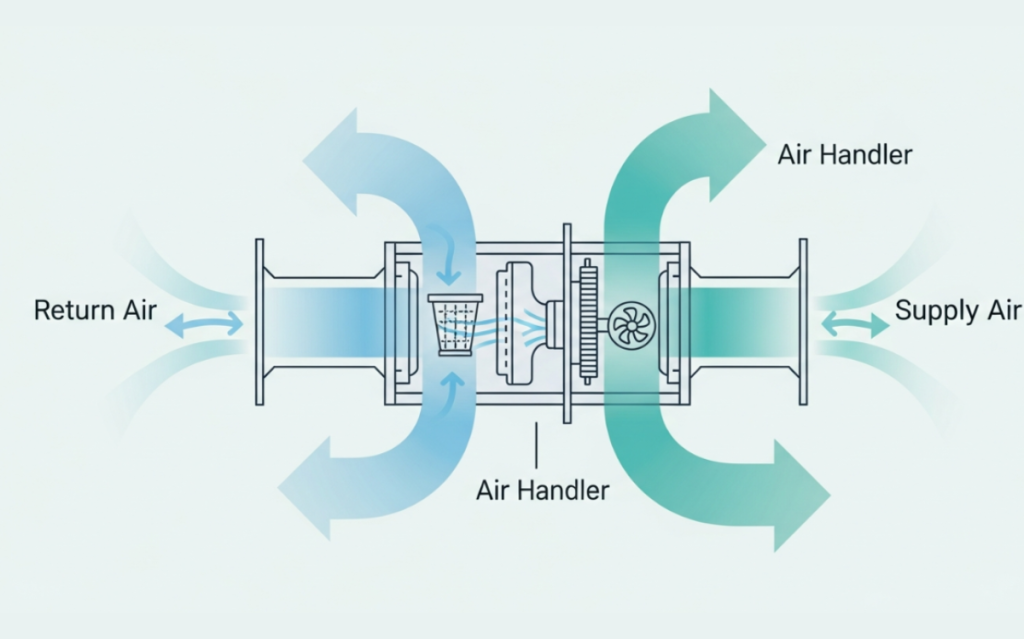
Every full HVAC system has two plenums, operating like inhale and exhale. Most homeowners never hear this breakdown, but once you do, airflow starts to make sense.
Supply Plenum: The Air Distributor
This is the plenum most people see when they look at their furnace, the one sitting on top of (for upflow) or below (for downflow) the air handling unit.
The supply plenum:
- Receives the heated or cooled air straight from the air handling unit.
- Pushes that conditioned air out into the ductwork.
- Operates under positive pressure, meaning it’s pushing air outward.
- Splits airflow into different duct branches that feed rooms throughout the house.
If you’ve ever felt one room blast with air while another barely gets a whisper, it’s often a supply plenum sizing or layout issue, not a duct issue.
Here’s the subtle truth HVAC pros see daily:
A supply plenum that’s even 10–20% too small can choke airflow and make a high-efficiency hvac system perform like a worn-out window unit.
Return Plenum: The Air Collector
If the supply plenum pushes, the return plenum pulls.
The return plenum:
- Collects unconditioned air from rooms.
- Operates under negative pressure, air is being drawn inward.
- Sends that air back to the HVAC unit for filtering, reheating, or cooling.
- Stabilizes airflow so your air handler isn’t starved for air.
Undersized or blocked return plenums are notorious for:
- loud airflow
- reduced indoor air quality
- higher energy bills
- premature blower motor failure
If the supply plenum controls distribution, the return plenum controls breathing. And a system that can’t breathe properly? It strains, overheats, freezes up, or fails.
Together, the two plenums form the backbone of your HVAC system’s entire air pathway.
Where Are Plenums Located?
Credits: MEP Engineering Tutorials
Most homeowners can’t spot a plenum even if they’re looking right at it. That’s because it looks like just another sheet metal box, one hidden in the shadows of your attic, basement, or utility closet.
Here’s the general layout:
1. Adjacent to the Furnace or Air Handler
Always. The plenum connects directly to your air handling unit like a docking bay.
2. Supply Plenum Positioning
Depending on your system configuration:
- Upflow furnace: supply plenum sits on top of the unit.
- Downflow furnace: supply plenum sits beneath the unit.
- Horizontal furnace or air handler: supply plenum sits on the end of the unit like a cap.
3. Return Plenum Positioning
Return plenums sit on the opposite side of the air handling unit, usually attached to the side where the return air filter slides in.
4. Sometimes It’s a Room, Not a Box
In older homes or commercial spaces, the “return plenum” isn’t a box at all, it’s a building cavity:
- A hallway ceiling
- An attic space
- A wall cavity
- A large chase
These setups are notorious for dragging in dust, insulation fibers, and attic debris, wrecking indoor air quality.
If you’re dealing with constant dust or poor air quality, check whether your return plenum is actually… your attic.
Functions of a Plenum

Most definitions of HVAC plenums stop at “it distributes air.” And sure, that’s technically true, but it massively undersells their impact. [2]
A plenum in HVAC systems does much more heavy lifting than most homeowners have ever been told.
Let’s break it down cleanly.
1. Distributes Conditioned Air Evenly
This is the obvious one. The supply plenum takes the conditioned air and divides it between ducts.
But here’s the nuance that matters:
A good plenum:
- manages air velocity
- dampens turbulence
- equalizes pressure before the air hits the duct system
A bad plenum creates hot-and-cold rooms, noise, and performance losses, no matter how good the HVAC equipment is.
2. Acts as a Pressure Zone
The idea of “positive” or “negative” pressure may sound technical, but think of it like lungs:
- Supply = exhale (pressure pushes air out)
- Return = inhale (pressure pulls air in)
If either lung is weak, you can’t breathe properly.
Pressure imbalances caused by poorly designed, undersized, or leaking plenums lead to:
- air whistling
- duct leaks
- blower motor strain
3. Facilitates Air Intake and Return
Return plenums make sure the system always has the right amount of air coming back.
If the return side can’t keep up, your system suffocates.
Symptoms homeowners notice:
- weak airflow from vents
- HVAC shutting off early
- freezing evaporator coils
- overheating furnaces
4. Supports Indoor Air Quality
This is the part most haven’t caught up to yet:
Your plenum directly impacts your air quality because it decides where your system pulls air from.
A sealed, properly installed plenum pulls air from the inside of your home.
A leaky return plenum?
It pulls air from:
- dusty basements
- moldy crawl spaces
- insulation-filled attics
And because HVAC systems run for hours every day, that polluted air gets circulated throughout the building.
If you’ve ever wondered why your house feels dusty no matter how often you clean, look at the return plenum.
Why Plenums Matter More Than Most Homeowners Realize
Here’s the uncomfortable truth in heating and cooling:
You can spend thousands on new HVAC systems, high-efficiency air conditioners, smart thermostats, and perfectly sized air ducts, but if your plenum is wrong, everything else is compromised.
A faulty, undersized, or poorly sealed plenum can wreck:
- efficiency
- comfort
- airflow
- equipment lifespan
- energy bills
- indoor air quality
Most HVAC contractors focus on the furnace or AC unit. But seasoned pros know to inspect:
- the shape of the plenum
- transitions between plenum and ducts
- leakage points
- sheet metal seams
- insulation quality
- return plenum sizing
Because the plenum is the first point where airflow stability is either built or broken.
It sets the tone for the entire system.
Why Poor Plenum Installation Causes Big Problems
Let’s break down what actually goes wrong when a plenum is done badly.
1. Undersized Plenums Restrict Airflow
If the plenum is too small, air can’t expand properly before hitting the ductwork.
It’s like breathing through a straw.
You’ll get:
- hot rooms
- cold rooms
- noisy ducts
- a furnace that short cycles
- an AC that freezes up
2. Leaky Plenums Pull Air from the Wrong Places
Especially return plenums.
If there’s a gap, a crack, or a poorly sealed seam, the plenum doesn’t care, it will suck in attic air, crawlspace air, or garage air instead of indoor air.
That means:
- dust
- insulation fibers
- humidity
- fumes
All pulled into your HVAC system and sent back through your vents.
3. Bad Transitions Waste Energy
A plenum that isn’t aligned to the air handler properly creates turbulence instead of smooth airflow. And turbulence = noise + wasted energy.
4. Wrong Materials Can Break Down
Cheap materials or DIY plenum boxes often collapse, leak, or warp.
A proper plenum is made from:
- heavy-gauge sheet metal
- or sealed, insulated duct board
Cut corners here, and you’ll feel it for years.
The Types of Plenums You’ll Actually Encounter
Homeowners rarely hear the “types of plenums” broken down clearly. Here’s the simple list.
- Supply plenum, sends heated or cooled air to ducts.
- Return plenum, collects indoor air and sends it back to the system.
- Cavity return plenum, uses a building cavity (hallway ceiling, attic, wall) instead of a box.
- Custom plenum box, built for tight spaces or remodels.
Understanding which one you have helps diagnose airflow issues.
How to Know If Your Plenum Is Causing Your Comfort Problems
Here are the three big red flags:
1. Uneven temperatures room to room
This is the #1 sign. A supply plenum that isn’t distributing air evenly or is too small will cause immediate imbalances.
2. Excessive dust
Often caused by leaky return plenums pulling unfiltered attic or crawlspace air.
3. Loud airflow or rattling
Usually a symptom of:
- pressure imbalance
- poor transitions
- undersized plenums
If turning on your air conditioning makes the house sound like it’s breathing loudly, you’ve got a plenum problem.
When to Call an HVAC Contractor
Any issues involving plenums should be handled by a professional because:
- Plenums must meet specific sizing guidelines.
- They must match your air handling unit’s airflow (CFM).
- They must seal into the ductwork properly.
- They must align with your system’s static pressure requirements.
Replacing a furnace or air conditioner without re-evaluating the plenum is one of the mistakes even experienced installers make.
Always ask:
“Will you be resizing or replacing the plenum during installation?”
If the answer isn’t confident and specific, get a second quote.
Final Thoughts: The Plenum Determines Your Comfort More Than You Think
Here’s the reality:
Most airflow issues don’t come from the furnace.
They don’t come from the ducts.
They don’t even come from the air conditioner.
They come from a stitched-together, overlooked plenum, the box that breathes life into the rest of your system.
Get the plenum right, and your HVAC system finally delivers the comfort it was designed for. Get it wrong, and you’ll keep fighting hot rooms, cold rooms, dust, noise, and high bills.
The plenum isn’t glamorous. It isn’t advertised. It doesn’t have a shiny logo or an efficiency rating.
But it decides everything.
Now you know what it actually does and why it matters for your home.
References
- https://www.energy.gov/sites/default/files/2022-07/job-aid-20-4_insulate-plenum_0.pdf
- https://en.wikipedia.org/wiki/Plenum_chamber