
You’ve probably had this exact moment before.
You walk into one room and it feels like an icebox, cold air blasting like the system’s stuck on overdrive. Then you step into another room and it’s the exact opposite, stuffy, warm, and begging for relief.
And here’s the thing most homeowners never realize: That temperature tug-of-war? That constant fighting between hot or cold spots?
It rarely starts at the thermostat. It usually starts inside your ductwork, with a silent metal component doing more work than anyone gives it credit for:
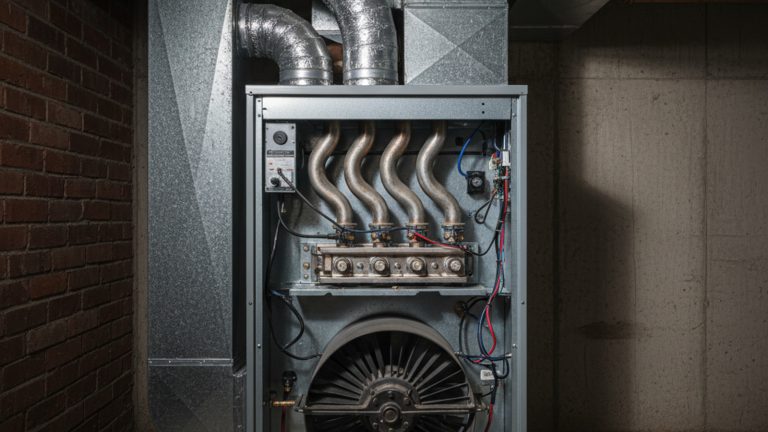
The HVAC damper. [1]
Most people never think about dampers until something goes wrong, rooms that won’t heat, airflow that’s weak, energy bills that creep higher every month.
But if you zoom in on the real mechanism that decides where your conditioned air goes, and how much of it reaches each space, it all comes down to these small, movable plates inside your ducts.
And once you understand how HVAC dampers work, the entire behavior of your heating and cooling system suddenly makes sense.
The Problem: Air That Doesn’t Go Where You Need It
Credits: GalcoTV
Let me paint the picture.
A homeowner calls because one room, the upstairs bedroom in the far corner, is always miserable. Doesn’t matter if the HVAC system is cooling or heating. It’s just never right. They’ve tried everything:
- They cracked windows (did nothing).
- They closed vents (made the system noisy).
- They bought fans, space heaters, blackout curtains… you name it.
Here’s what everyone gets wrong: Closing vents at the room level is not how you control airflow. The HVAC system doesn’t respond to it the way you think, it actually throws the system off balance, sometimes even damaging components over time.
But when I walk into a home like this, I already know what’s happening: the flow of air isn’t being managed at the source.
The ducts are pushing conditioned air everywhere except where the homeowner needs it most.
And nine times out of ten, the fix isn’t a new furnace or a bigger AC unit, it’s understanding and adjusting the HVAC dampers.
This is the part most homeowners haven’t caught up to yet.
The Stakes: Poor Airflow Isn’t Just Annoying, It’s Expensive
What starts as a comfort problem slowly becomes:
- Higher energy bills
- Shortened system lifespan
- Low indoor air quality
- Uneven heating and cooling that never improves
Your HVAC system is designed to move a precise amount of conditioned air through your home. When certain areas get too much air and others get almost none, the system compensates. It strains. It runs longer. It short-cycles. It wastes energy.
All because the airflow was never balanced using the one component actually designed for the job: the duct damper.
This is why understanding dampers matters. They’re not accessories, they’re the steering wheel for your HVAC airflow.
The Mechanism: What an HVAC Damper Actually Is
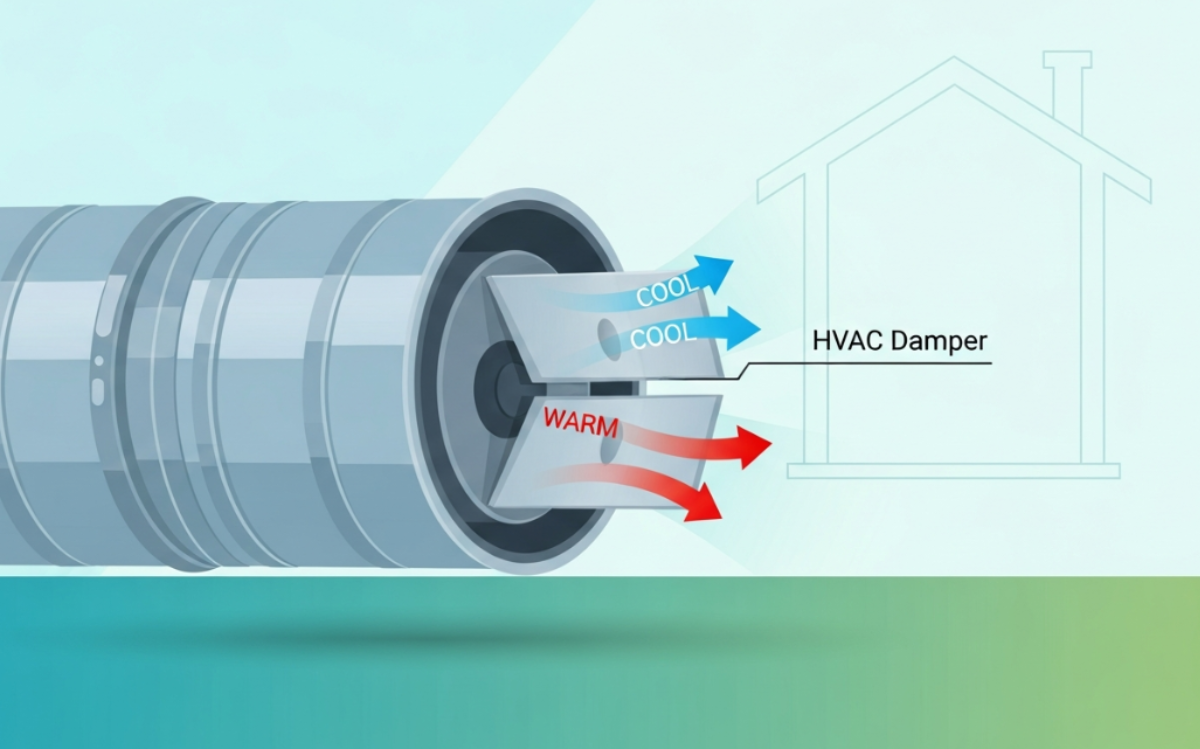
At its simplest, an HVAC damper is a movable metal plate, sometimes a blade, sometimes a valve, hidden inside your ductwork. Think of it like a gatekeeper.
When it’s open, air flows freely. When it’s closed, it blocks air. When it’s partially open, it balances air.
That’s it. Simple idea. Massive impact.
Dampers give you control over:
- Where air goes
- How much air each room receives
- Whether rooms are individually heated or cooled
- Whether your HVAC system runs efficiently or fights itself
In other words: HVAC dampers control the entire personality of your heating and cooling system.
Defining HVAC Dampers and Their Function
Let’s break it down clearly, without the jargon.
An HVAC damper is:
- A movable plate or valve inside your ductwork
- Designed to control airflow by opening or closing
- The key component that decides how much conditioned air each part of your home receives
- One of the most overlooked parts of any HVAC system
While vents in your rooms feel like the “controls,” those are really just cosmetic. If vents are the light switches, dampers are the electrical panel, the real place where power gets managed.
When dampers open or close, they can:
- Increase airflow to a room
- Decrease airflow to a room
- Completely shut off airflow to certain zones
- Redirect conditioned air to the spaces that need it most
And because this control happens inside the ductwork, upstream, it’s far more effective than any register you adjust by hand.
The Importance of Dampers: Zoning and Energy Efficiency

Here’s where dampers take a leap from “nice to understand” to “game-changing.”
Dampers make HVAC zoning possible.
A zoning system allows you to divide your home into different areas, each with its own temperature control.
Without dampers, zoning simply isn’t possible. With dampers?
You unlock the ability to:
- Heat your bedrooms at night without overheating your living room
- Keep upstairs comfortable without freezing the downstairs
- Reduce energy waste by conditioning only the areas you’re using
- Solve comfort issues at the duct level instead of chasing symptoms
Zoning systems rely on automatic dampers that open and close based on thermostats in each zone. If the basement needs cooling, that zone’s damper opens. If the upstairs doesn’t, that damper stays closed.
Simple. Precise. Efficient.
Why this matters more than ever:
- Homes are bigger.
- Families use rooms differently.
- Energy efficiency isn’t optional anymore.
When dampers aren’t set correctly, or when a home was never balanced in the first place, you end up with a system that runs harder than necessary, wasting money and wearing itself out prematurely.
Types of HVAC Dampers
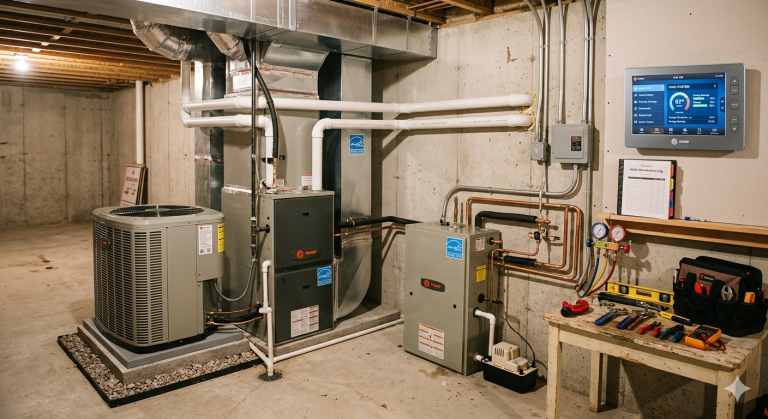
Now let’s clear up something: not all dampers are created the same [2]. Homeowners often assume there’s just one kind. In reality? There are several, each designed for specific airflow challenges.
1. Zone Dampers
These are the stars of the modern zoning system.
Zone dampers are:
- Automatic dampers that respond to thermostats
- Used to heat or cool specific zones independently
- The foundation of an HVAC zoning system
If you’ve ever wanted your upstairs and downstairs to behave like separate homes when it comes to HVAC, these are the components making it happen.
2. Backdraft Dampers
Backdraft dampers act like one-way valves.
They:
- Allow airflow in one direction
- Prevent air from flowing backward when the system is off
- Protect the home’s pressure balance
- Often sit in fresh-air intake systems and exhaust ducts
Without them, your ducts become highways for unwanted outside air.
3. Louver Dampers
These are the most common residential dampers.
Louver dampers:
- Use metal blades to open and close
- Automatically close under higher pressure
- Are ideal for balancing large sections of airflow
Whenever someone talks about “blade dampers,” they’re usually referring to this category.
Bonus: Other Dampers You Might Hear About
Some terms come up more in commercial systems, but as a homeowner, it’s helpful to know they exist:
- Butterfly dampers – circular plates that rotate to block airflow
- Guillotine dampers – slide into place like a blade
- Inlet vane dampers – adjust airflow at the blower intake
- Volume control dampers – used to fine-tune airflow across zones
You don’t need to memorize them. But knowing the landscape helps you understand how flexible your duct system really is.
Where Are Dampers Located?
This is the question every homeowner eventually asks, usually after hearing a tech say, “We just need to adjust your manual dampers.”
The truth? Dampers hide in plain sight.
You’ll typically find them:
- In the main supply trunk near your furnace or air handler
- Along branches leading to major rooms or sections of the home
- Sometimes behind access panels
- Almost always within the ductwork, not at the register
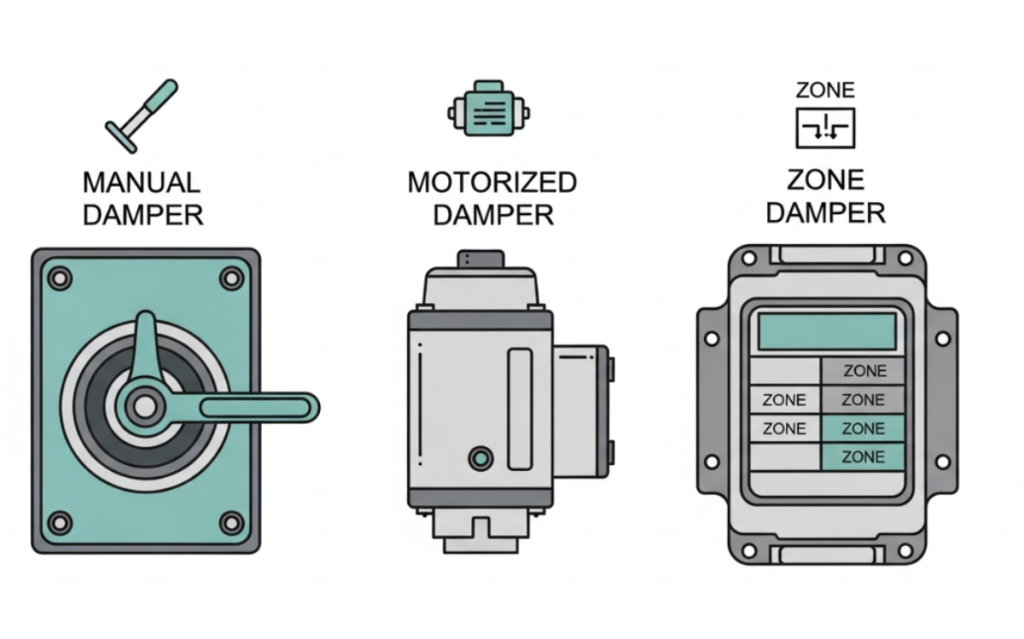
If your system has manual dampers, you’ll spot them by the small handle or wing-nut that controls the blade position.
If your system has automatic dampers, you’ll see a small motor (called an actuator) mounted outside the duct.
How Dampers Actually Work (The Simple Version)
Think of a damper like the valve on a garden hose.
- Turn it one way: more water.
- Turn it the other: less water.
- Fine-tune the middle: perfect pressure.
Dampers do the same thing with the flow of air.
When a damper is open, the system pushes more conditioned air through that duct. When the damper is closed, that duct gets little or no air. When it’s partially open, it balances airflow throughout the ductwork.
This is why HVAC pros spend so much time “balancing” systems, setting each damper to the precise position needed for the home to feel comfortable in every room.
It’s a dance between airflow, pressure, duct size, and room load.
And dampers are the choreographers.
Why Your Home Probably Needs Damper Adjustment
Here’s the uncomfortable truth: Most homes were never balanced properly when they were built.
Builders focus on getting the HVAC system functional, not optimized. Dampers get left wide open, or set without measuring room-by-room airflow. That means your system has been guessing where air should go since day one.
Signs your dampers need attention:
- Rooms that are too hot or too cold
- Weak airflow from certain vents
- One area of the home always uncomfortable
- Loud duct noise or whistling
- High energy bills with no explanation
- A system that runs too long or short cycles
These aren’t symptoms of a failing HVAC system, they’re signs of an unbalanced one.
Manual Dampers vs. Automatic Dampers
Manual Dampers (Adjusted by Hand)
You physically adjust these by rotating the handle outside the duct.
Homeowners love them because:
- They’re simple
- They’re reliable
- They’re inexpensive
- They give immediate airflow changes
But they have limits:
- You can’t easily adjust them seasonally
- They don’t respond to temperature changes
- They aren’t ideal for dynamic zoning systems
Automatic Dampers (Controlled by Thermostats)
These are the heart of modern zoning.
Automatic dampers:
- Open and close based on zone thermostats
- Let you heat or cool different parts of the home independently
- Offer the highest level of comfort and efficiency
- Work seamlessly with smart thermostats
If you’ve ever wondered how luxury homes get perfect comfort across multiple floors, it’s because automatic dampers are controlled by a system that knows exactly where to send conditioned air.
Benefits of Using HVAC Dampers: A Summary
Let’s bring it home.
These are the benefits from these dampers:
1. Balanced Airflow
Instead of one room freezing while another barely gets a whisper of air, the dampers spread things out so each space feels the way it should.
2. Personalized Comfort
You control temperatures by room or zone, not just one central thermostat.
3. Major Energy Savings
Your HVAC system no longer wastes conditioned air where you don’t need it.
4. System Protection
Balanced airflow prevents overheating, freezing coils, and pressure issues.
5. Smoother, More Reliable Performance
When the airflow is balanced, the system doesn’t have to fight itself.
The blower isn’t pushing against closed-off ducts, the coils aren’t freezing, and the furnace isn’t overheating.
Everything just runs the way it was meant to, steady, steady, steady.
6. Better Air in the Rooms You Actually Live In
When air moves the way it should, you don’t get those weird pressure swings that pull dust in from attics or crawlspaces.
Rooms feel fresher, less stuffy, and the whole house breathes the way a home should.
Dampers may be invisible, but their impact is felt in every room of your home.
The Bottom Line: Dampers Are the Quiet Powerhouse of Your HVAC System
Most people think airflow is controlled by vents. It’s not.
Most people think uneven temperatures mean they need new equipment. They don’t.
Most people think HVAC systems are fixed by thermostats. They aren’t.
The real solution lives deeper, in the ducts, inside these small adjustable gates that decide where your air goes, how much your home is heated or cooled, and how efficiently your system runs.
If you’ve been battling comfort issues, uneven rooms, or surprise energy bills, it’s time to stop treating symptoms and start addressing the root cause:
Your HVAC dampers need to be understood, adjusted, or upgraded.
Because once the system is balanced? Your entire home feels different.
And you finally get the comfort you were paying for all along.
References
- https://en.wikipedia.org/wiki/Heating,_ventilation,_and_air_conditioning
- https://people.eecs.berkeley.edu/~culler/cs294-f09/m197content.pdf