

You can picture the moment. You walk into a store on a muggy afternoon, expecting relief, but the air feels tired, like it gave up halfway through the cooling cycle. The manager shrugs and says, “It’s the rooftop unit again.” Most people nod politely, pretending they know what that means.
But if you’re a homeowner, the part most folks haven’t caught up to yet is this: the same technology keeping that store comfortable sits at the center of countless homes, shops, and small buildings, quietly running the show, often unnoticed until it slips.
And once you understand what an RTU really is and how it works, the whole landscape of HVAC systems starts to make a lot more sense.
The stakes are simple. Your comfort, your energy bill, and the lifespan of your HVAC equipment all get shaped by how well you understand the tools controlling your indoor climate.
An RTU isn’t just a metal box on a roof. It’s a stitched-together powerhouse that pulls in outdoor air, filters it, conditions it, and pushes it through your building in a carefully balanced rhythm.
And knowing how it works gives you leverage, whether you’re troubleshooting a hot zone in your home or deciding what kind of hvac unit you should invest in next.
Let’s break it down.
Defining the RTU: Packaged HVAC on Your Roof
Credits: The Engineering Mindset
A rooftop unit [1], often shortened to RTU HVAC, is a packaged HVAC system that places all the key components inside a single cabinet installed on the roof. No scattered equipment, no maze of indoor units; everything is housed together, fully self-contained. That’s the first surprise for many homeowners. Instead of multiple pieces working in distant corners of a building, one packaged rooftop unit handles the entire cycle of heating and cooling from start to finish.
Why is it installed on the roof? It’s a smart mix of practicality and design. By moving the equipment above the building, you free up indoor space, reduce noise, simplify duct layout, and create easier access for service techs. The quieter home office, the decluttered utility room, the cleaner look, those all bleed directly from this design choice.
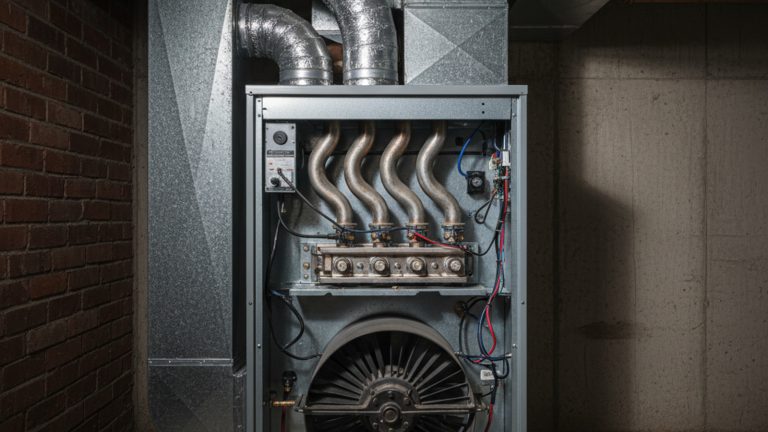
Inside the cabinet is a lineup of unsung heroes:
- A blower that pulls in outdoor air and circulates conditioned air throughout the building.
- A compressor that drives the direct expansion cooling cycle.
- An evaporator coil that absorbs heat indoors.
- A condenser coil that releases heat outside.
All in one box. All working in sync. If you’ve ever wondered why some buildings feel consistently balanced despite big temperature swings outside, this is usually why.
How an RTU Works: A Centralized System
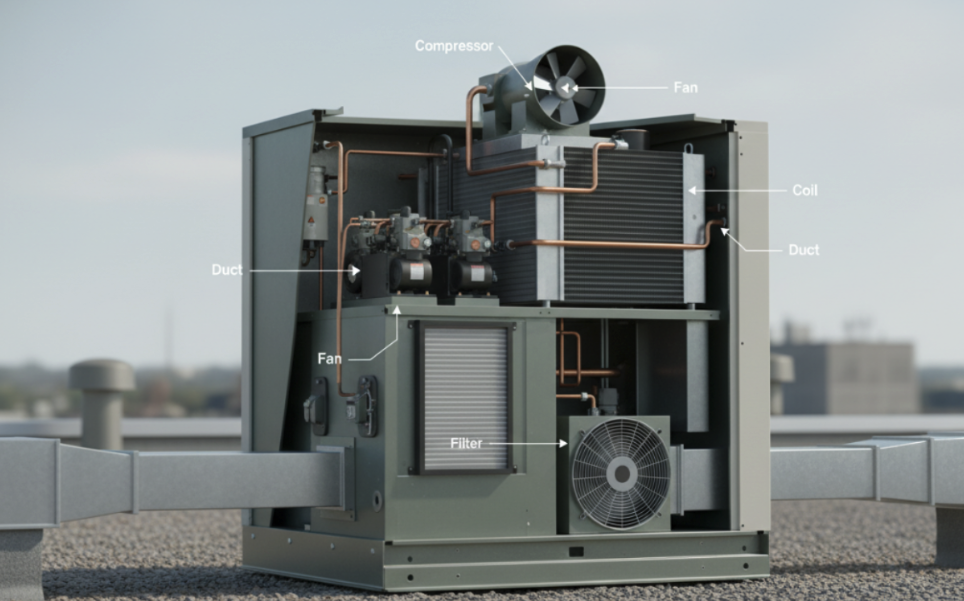
Here’s the part everyone gets wrong: they think an RTU simply blows cold air inside like a giant fan on the roof. But the mechanism is far more deliberate. Picture a packaged rooftop unit acting like the building’s lungs, pulling in air, cleaning it, transforming it, and sending it where it needs to go.
It starts with intake. Outdoor air enters the rtu hvac system through dampers, and a supply fan pulls it across filters. If the building needs fresher air, the dampers open wider. If it needs to conserve energy, they tighten. This mix of outdoor air and return air forms the foundation of your indoor environment.
Then the magic begins:
- The evaporator coil cools or dehumidifies the air when the cooling cycle kicks in.
- The heat exchanger warms air when the system needs to provide heating.
- The expansion device regulates refrigerant flow during direct expansion.
- The system balances indoor temperatures through carefully calibrated air handling.
Once conditioned, the air travels through ducts into every corner of the building. And here’s the part most people never consider: the return air journey. After the conditioned air moves through the space, it loops back through a dedicated return air path, feeding into the unit again. The RTU compares the incoming air to the thermostat’s demands and starts another cycle, minute after minute, day after day.
That loop is why small leaks, dusty filters, or poorly sealed ducts can ripple into comfort issues that feel bigger than they are. The entire cycle depends on a clean, steady flow.
Benefits of RTUs: Space Saving and Simplified Maintenance
Every homeowner knows the quiet battle between comfort and square footage. RTUs win that battle by lifting the equipment off the ground entirely. No bulky indoor hvac units stealing closet space. No outdoor air units cluttering the patio. It’s all on the roof, out of sight, out of your way.
But space isn’t the only benefit.
The implication most folks miss is that RTUs simplify maintenance. Technicians don’t need to crawl into attics, dodge insulation, or maneuver through cramped utility closets. With everything housed in one rooftop cabinet, service becomes faster, cleaner, and often cheaper.
And because the entirety of the system is packaged, it’s perfect for buildings with large, open floorplans, think retail stores, warehouses, or offices. These spaces need predictable, centralized heating and cooling that doesn’t interrupt the layout or add noise. A packaged rooftop system gives them that consistency.
It had everything in one cabinet. It sat quietly above the building. It delivered heating and cooling without stealing a single square foot indoors.
That’s the appeal.
RTUs vs. Split Systems: Key Differences
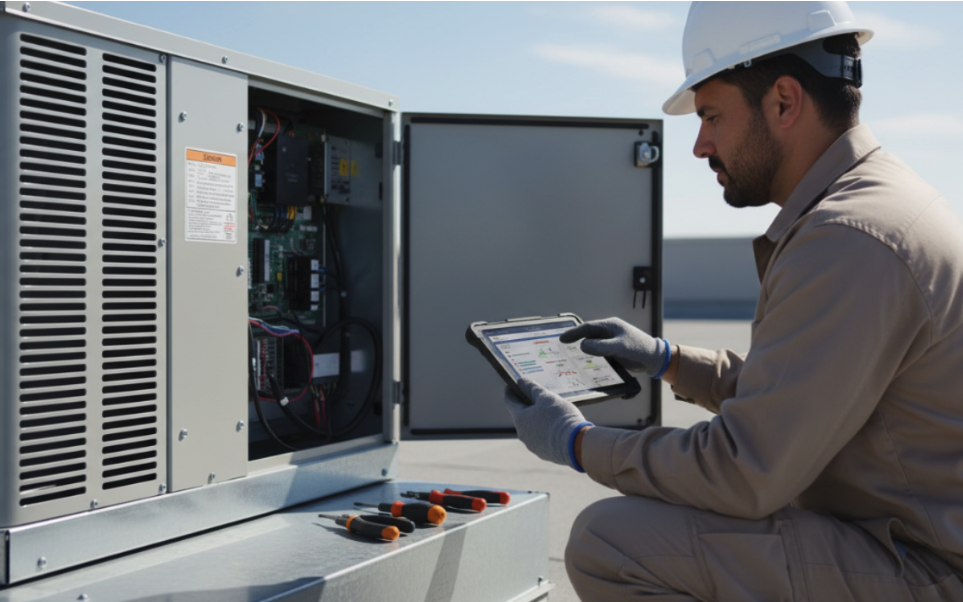
Here’s the moment where a lot of homeowners take a wrong turn without realizing it. On the surface, an RTU and a split system feel like two versions of the same idea, just different packaging. But the reality hits differently once you’re living with the choice day after day, especially when something breaks or your energy bill spikes.
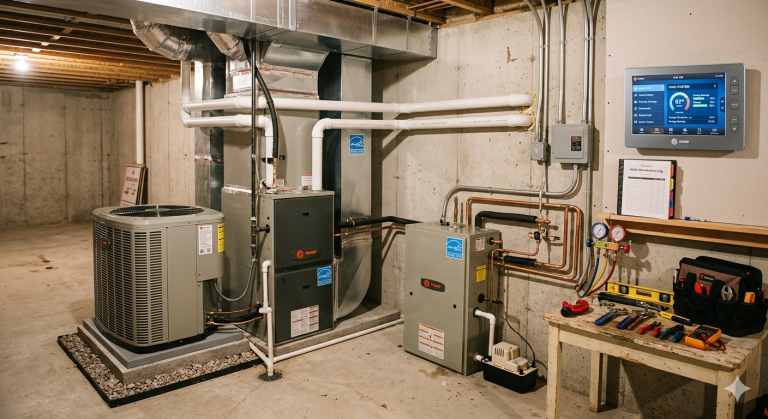
An RTU is the all-in-one package. Everything, the compressor, blower, evaporator coil, condenser coil, heat exchangers, sits together in one cabinet, usually installed on the roof, quietly doing its job out of sight. A split system, on the other hand, spreads the workload: an outdoor condenser outside, an indoor air handler or furnace tucked somewhere inside your home.
And that single design difference cascades into very different experiences.
RTU Advantages
- It goes in fast. One box, one location, one lift.
- It stays out of your living space, which means no hum vibrating through your walls.
- Maintenance is straightforward because techs aren’t hunting through closets or crawlspaces.
RTU Limitations
- If your roof is steep, tall, or just plain hard to reach, every service visit becomes a small expedition.
- They shine in commercial settings, but most homes simply aren’t built with RTUs in mind.
Split System Advantages
- They’re designed around residential life, hallways, basements, garages, attics.
- More options, more sizes, more ways to tailor the system to an exact house layout.
- They mesh easily with existing ductwork, which keeps installation cleaner and cheaper.
Split System Limitations
- You now have equipment in two places, which means more parts to service and more potential points of failure.
- You need to sacrifice indoor space for the air handler, and that space doesn’t give back.
The simplest truth? RTUs trade flexibility for convenience. Split systems trade convenience for control.
Both can deliver excellent heating and cooling, you just have to decide whether you want everything tucked away in one rooftop unit or distributed throughout the home where each piece has its own job and its own demands.
RTU Components: A Closer Look
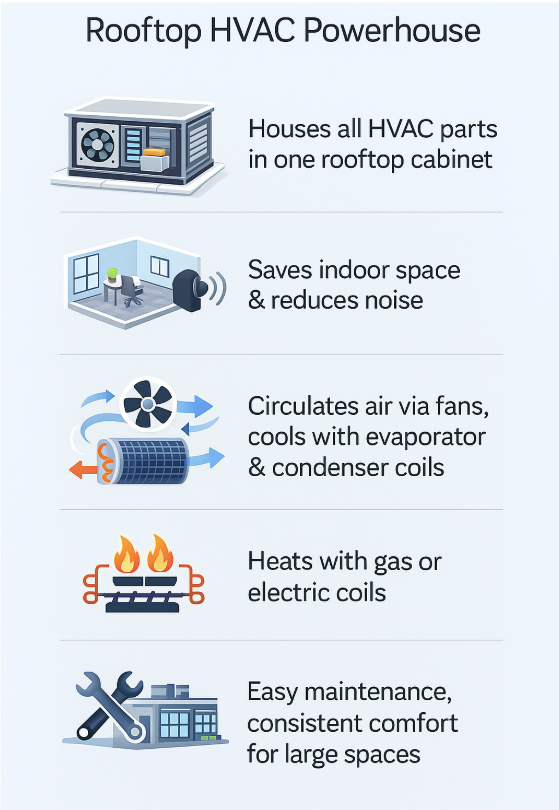
Homeowners often see an RTU as a single machine, but inside it’s a field of specialized components, each one doing a precise job. Understanding these pieces helps you troubleshoot small issues before they turn into major failures.
Cooling begins with a direct expansion refrigerant cycle where:
- The evaporator coil absorbs heat from the incoming air.
- The compressor pressurizes the refrigerant.
- The condenser coil pushes that heat into the outdoor air.
- The expansion device resets the pressure for the next cycle.
If your building ever feels like it’s cooling unevenly, one of these steps is usually the culprit.
Heating operates differently. Many rooftop units use gas combustion or electric resistance coils, each acting as a compact heat exchanger that warms air before distribution. That same blower then sends the conditioned air through the ducts, creating the comfort you feel indoors.
Ventilation is baked in as well. A rooftop unit doesn’t just move indoor air around; it actively manages outdoor air intake to maintain healthier air quality. When a system is properly balanced, you get fresher air, fewer pollutants, and better humidity control.
Tying it all together is the control system. Thermostats, pressure switches, flow sensors, they constantly adjust airflow, refrigerant movement, and temperature. They assume, prioritize, and adjust thousands of times a day without you noticing. If it ever feels like the air conditioning is “thinking,” in a way, it is.
RTU Applications and Considerations
Rooftop units dominate commercial skylines for a reason, but homeowners occasionally use them too, especially in flat-roofed homes or buildings needing a single, consolidated hvac system.
RTUs thrive when:
- The building needs a clean footprint without indoor equipment.
- Easy access for service is a priority.
- Integration with a building management control system is desired.
Many modern packaged rooftop units come ready to link into intelligent controllers that monitor performance, energy usage, and even outdoor air intake percentages. You can see temperature trends, diagnose leaks, or adjust ventilation remotely. That’s the kind of insight older hvac equipment could never provide.
Energy efficiency is another factor. While older RTUs burned through electricity, newer models use variable-speed fans, modulating burners, and smarter sensors to keep everything finely tuned. That’s especially powerful when paired with consistent maintenance, clean filters, unobstructed return air paths, and balanced ducts. [2]
And here’s the part homeowners underestimate: RTUs make troubleshooting easier. With all major components in one place, technicians can quickly identify whether the issue sits in airflow, refrigerant, electrical, or controls. Fewer blind spots mean faster fixes.
RTU: Remote Terminal Unit (Other Contexts)
Just to clear up the confusion you might stumble across online, RTU can also mean remote terminal unit, a totally different piece of industrial technology used for monitoring and control in fields like water treatment or power distribution.
Different technology. Different purpose. Different world.
But in HVAC, an RTU always means rooftop unit or roof top unit: the packaged rooftop system conditioning the air inside your building.
Staying Ahead of Comfort Problems
Understanding what an RTU is, and what it quietly handles for you, changes how you think about your home’s comfort. You start noticing airflow patterns. You hear slight changes in the supply fan. You recognize when the outdoor air dampers are pulling harder than usual. The system goes from mysterious box to familiar partner.
And once you see how many hvac systems depend on this kind of carefully balanced process, you start asking better questions. How old is the equipment? When was it last serviced? Are the ducts sealed? How’s the ventilation mix? Those questions lead to better performance, lower bills, and far fewer surprises on sweltering or freezing days.
If you’re looking to upgrade your system, get maintenance, or choose between a packaged rooftop unit and a split system, reach out to [brand placeholder]. They can help you size, select, and service the right equipment so your building stays comfortable no matter what’s happening outside.
References
- https://faultdetection.lbl.gov/dataset/rtu/
- https://betterbuildingssolutioncenter.energy.gov/sites/default/files/attachments/Heat%20Pump%20RTU%20Considerations.pdf