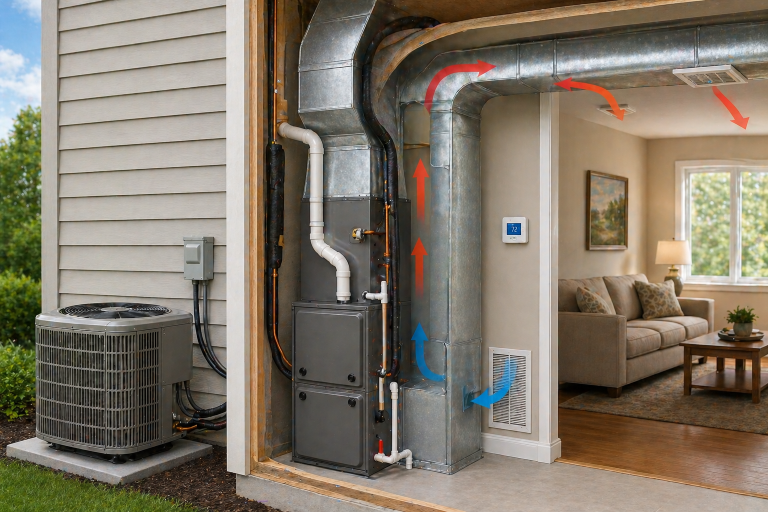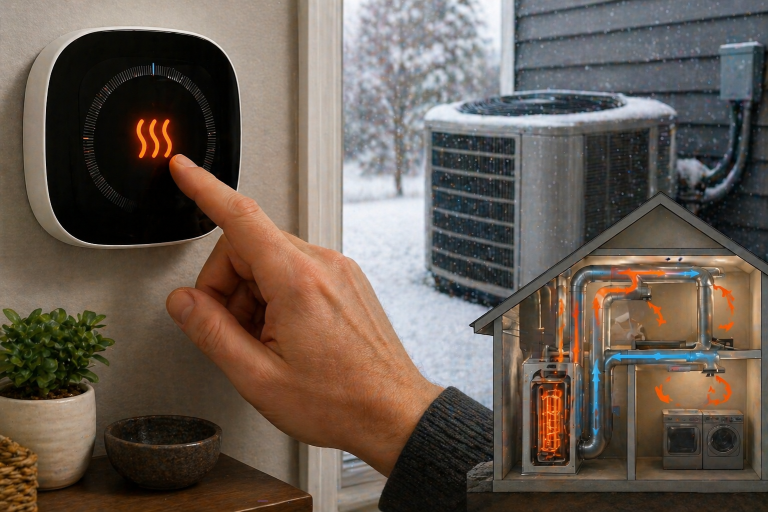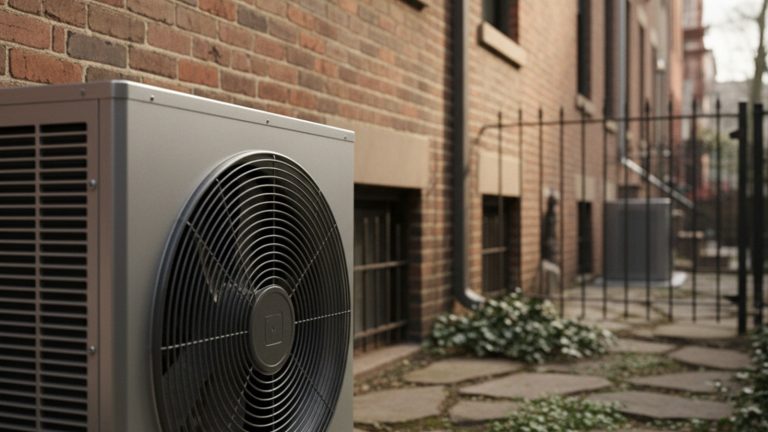

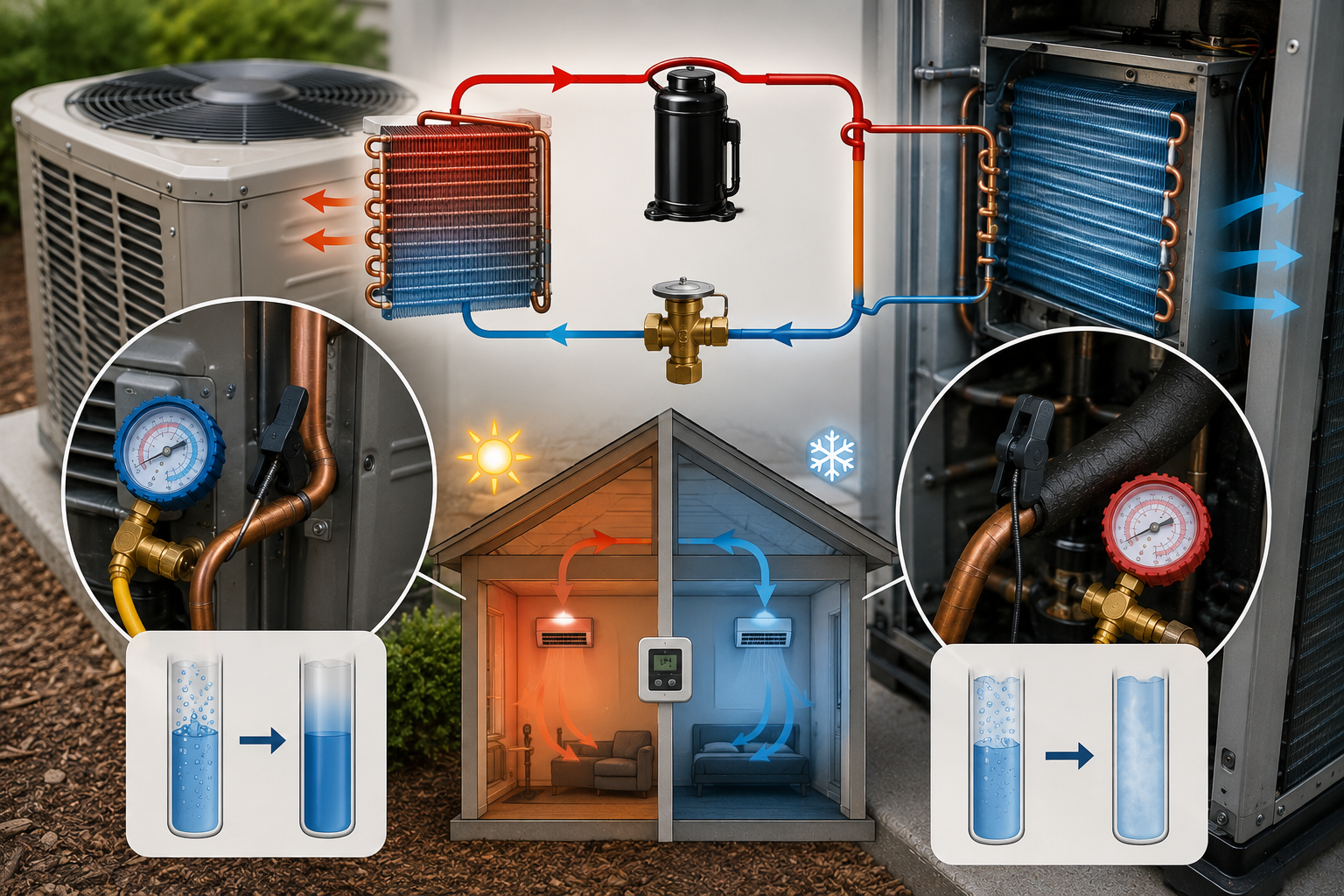
A standard residential air conditioning system cycles refrigerant through your home to absorb indoor heat and release it outside. When the summer temperatures spike, that continuous cycle determines whether your indoor air stays at a comfortable 72 degrees or creeps up into the eighties.
Homeowners often hear technicians mention technical terms during annual maintenance visits. Understanding what is subcooling HVAC helps you recognize when your system runs efficiently and when it might be losing refrigerant.
The Basics of Subcooling in Your Air Conditioner
Subcooling measures how much a liquid refrigerant cools down below its saturation temperature, which is the exact point where it turns from a gas into a liquid. This process takes place entirely in the outdoor condenser coil of your air conditioning unit.
Think of it like boiling water on a stove, where water turns to steam at 212 degrees Fahrenheit. If you capture that steam, cool it until it turns back into water at 212 degrees, and then cool that water further down to 200 degrees, you have 12 degrees of subcooling.
In your cooling system, the compressor pumps hot, high-pressure refrigerant gas into the outdoor coil. The outdoor fan blows air across the coil to remove heat, causing the gas to condense into a liquid.
Once the refrigerant becomes a liquid, it continues to shed heat as it travels through the rest of the condenser coil. Technicians check this temperature drop to confirm the system holds the correct refrigerant charge.
How Subcooling and Superheat Work Together
While subcooling happens in the outdoor unit, superheat takes place inside your home at the evaporator coil. Superheating is the process of warming a refrigerant gas above its boiling point after it absorbs heat from your indoor air.
Technicians measure these two values at different ends of the refrigeration cycle to diagnose performance issues. Subcooling is checked at the outdoor liquid line, while superheat is measured near the indoor evaporator or at the compressor suction line.
Modern air conditioners often use a thermal expansion valve to control the flow of liquid refrigerant into the indoor coil. Systems with this valve rely on accurate subcooling measurements to verify the refrigerant charge.
If a system uses a fixed orifice instead of a thermal expansion valve, technicians will look closer at the superheat numbers. Checking both values paints a complete picture of how well the equipment moves heat out of your house.
Why Accurate Refrigerant Levels Save You Money
A residential air conditioner accounts for about half of a typical household’s summer energy consumption. Keeping the subcooling measurement within the manufacturer’s target range directly impacts your monthly utility bills.
When the system cools the liquid refrigerant properly, it guarantees a solid column of liquid reaches the thermal expansion valve. This solid stream of liquid maximizes the system’s ability to absorb heat from your indoor air.
An incorrect charge disrupts this flow and forces the equipment to work harder to maintain your thermostat setting. A precise measurement offers several specific benefits for your household budget and equipment longevity:
- Prevents flash gas: A solid column of liquid stops refrigerant from turning back into a gas prematurely, which wastes energy before it reaches the indoor coil.
- Maximizes cooling capacity: Proper liquid levels ensure the indoor evaporator coil can absorb the maximum amount of heat per cycle.
- Reduces energy consumption: An efficient refrigeration cycle shortens the time the compressor needs to run, lowering electricity costs.
- Extends compressor life: Correct refrigerant levels keep the compressor from overheating, saving you from a premature and expensive replacement.
Symptoms of an Incorrect Refrigerant Charge
Most residential HVAC systems require a subcooling measurement between 10 and 15 degrees Fahrenheit. When the number falls outside this range, the system will start displaying noticeable symptoms inside the house.
A low subcooling number usually means the system is undercharged, which often points to a refrigerant leak somewhere in the copper lines. A high number suggests the system holds too much refrigerant or has a blockage in the liquid line.
Homeowners should watch for specific warning signs that indicate the refrigerant cycle is out of balance. These symptoms often appear during the hottest weeks of the year when the system works its hardest:
- Warm air from vents: An undercharged system cannot absorb enough heat, resulting in lukewarm air blowing into your rooms.
- Constant running: If the house will not cool down to the thermostat setting, low refrigerant might be preventing the system from finishing a cycle.
- Ice on the indoor coil: Low pressure from a refrigerant leak can cause the indoor evaporator coil to freeze solid.
- Short cycling: An overcharged system with high subcooling may cause the compressor to turn on and off rapidly to protect itself from high pressure.
Hiring a Professional for Refrigerant Repairs
Handling air conditioning refrigerant requires specific Environmental Protection Agency (EPA) Section 608 certifications. Federal law prohibits unlicensed individuals from buying, handling, or disposing of these chemical coolants.
Measuring subcooling requires specialized equipment, including a calibrated pressure gauge and digital temperature probes attached to the copper lines. A technician uses these tools to read the pressure and convert it to a saturation temperature.
Once they have the saturation temperature, they subtract the actual liquid line temperature to find the exact subcooling value. This math tells them precisely how many ounces of refrigerant to add or remove.
Homeowners should schedule a service call if they notice rising energy bills or poor cooling performance. Attempting to attach gauges or add refrigerant without training often leads to severe compressor damage.
Frequently Asked Questions
What does 10 degree subcooling mean?
This means the liquid refrigerant has cooled 10 degrees below its condensation point before leaving the outdoor unit. For many high-efficiency units installed in 2026, a 10-degree drop indicates the system is fully charged and operating at peak performance.
What is the normal subcooling for R-410A?
Most residential systems using R-410A require a measurement between 8 and 14 degrees Fahrenheit. You can find the exact target number printed on the manufacturer’s data plate attached to the side of your outdoor condenser.
Can I measure subcooling myself?
You should not attempt to measure this yourself unless you hold an active EPA certification. Attaching a pressure gauge incorrectly can release harmful chemicals into the air and cause severe frostbite to your hands.