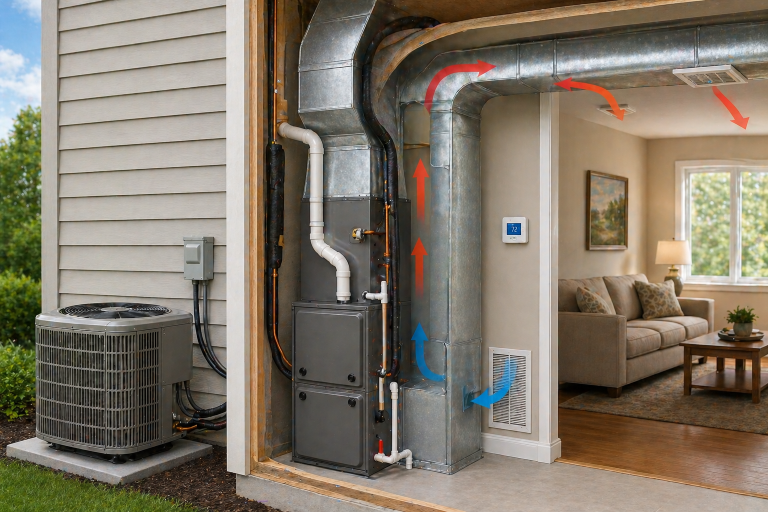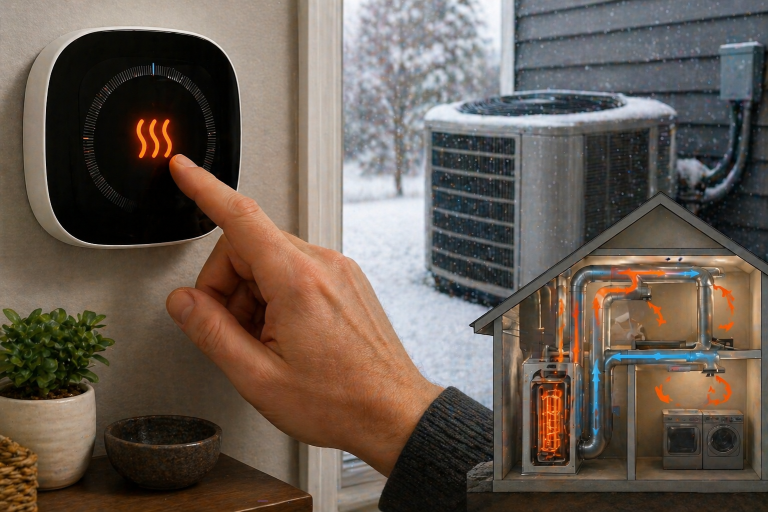

Replacing a heating system in New England requires careful planning to handle our brutal winter temperature drops. When January temperatures in Worcester MA plummet toward single digits, an undersized heating unit will leave your living space uncomfortably cold. Homeowners often ask what size furnace do I need to keep their property warm without burning through excess energy.
Choosing the right heating capacity is about matching the equipment to the specific thermal profile of your house. A system with too much capacity creates just as many problems as one with too little. Nailing the exact required output ensures consistent indoor temperatures and keeps your utility bills manageable throughout the long heating season.
How Furnace Sizing Works
Heating capacity is measured in British thermal units – commonly referred to as BTUs. One BTU represents the amount of energy required to raise the temperature of one pound of water by one single degree Fahrenheit. Residential furnaces typically come in standard size increments ranging from 40,000 up to 120,000 BTUs.
To find a starting estimate for your house, HVAC professionals use a basic formula multiplying your total square footage by a climate zone factor. You also have to account for the difference between input BTUs and output BTUs based on the efficiency rating of the equipment. A 95% AFUE furnace rated at 100,000 input BTUs actually delivers 95,000 BTUs of usable heat into your ductwork.
Understanding this input-versus-output dynamic prevents you from accidentally installing a unit that underperforms. Buying a lower efficiency model means you might need a higher starting input rating to achieve the actual heating output your home requires.
BTU Requirements by Square Footage
The United States is divided into different climate zones to help standardize heating requirements based on regional weather patterns. Worcester MA sits squarely in Climate Zone 5A, which is characterized by heavy heating demands and cold, prolonged winters. Homes in this region generally require between 45 and 50 BTUs per square foot of living space to maintain a comfortable temperature.
Using this regional multiplier gives homeowners a solid baseline expectation before an HVAC technician performs a detailed assessment. Warmer southern climates might only need 25 BTUs per square foot, but our local weather demands much more robust heating power.
Here is a standard baseline estimate for homes in Climate Zone 5A based on total square footage:
- 1,000 square foot home: 45,000 to 50,000 BTUs
- 1,500 square foot home: 67,500 to 75,000 BTUs
- 2,000 square foot home: 90,000 to 100,000 BTUs
- 2,500 square foot home: 112,500 to 125,000 BTUs
These figures serve as a preliminary guide rather than an absolute rule. Every property has unique architectural features that will shift these baseline numbers up or down.
Factors That Affect Furnace Sizing
Square footage provides a helpful starting point, but it only tells a fraction of the story. The physical characteristics of your house drastically alter how much heat escapes through the walls and roof. Two houses sitting side by side with identical floor plans could require entirely different heating capacities based on their construction materials.
The age of your property plays a massive role in heat retention, especially with older New England architecture. Historic properties often suffer from significant air leakage and poorly insulated wall cavities compared to modern builds.
An HVAC professional will evaluate several specific variables to adjust your baseline BTU requirements:
- Insulation quality: Upgrading attic insulation from R-19 to R-38 can reduce your heating load by up to 20%.
- Window types: Single-pane glass loses substantially more heat than double-pane or triple-pane alternatives.
- Ceiling height: Vaulted ceilings increase the total volume of air your system must heat.
- Ductwork condition: Leaky or undersized air ducts prevent heated air from reaching your rooms efficiently.
- Sun exposure: The orientation of your house and the number of south-facing windows impact natural solar heating.
Improving your home envelope through air sealing and insulation upgrades can actually drop your requirement from 50 BTUs per square foot closer to 40. This means investing in insulation might allow you to purchase a smaller, less expensive heating system.
What Happens If Your Furnace Is the Wrong Size
Installing a unit with incorrect capacity guarantees long-term performance issues and premature equipment failure. An oversized furnace will short-cycle, meaning it blasts the house with hot air and shuts off rapidly before completing a full, efficient run. This constant turning on and off wears out mechanical components faster and causes uncomfortable temperature swings between rooms.
Short-cycling can also increase your overall energy consumption by 10 to 15 percent compared to a properly sized unit. You end up paying more upfront for a larger unit only to suffer higher monthly utility bills and reduced equipment lifespan.
An undersized system creates an entirely different set of frustrating problems during the winter months. When local temperatures drop below 10 degrees, a unit lacking sufficient BTUs will run continuously without ever reaching your thermostat setting. This constant strain drives up your natural gas or electricity costs while leaving you shivering in your own living room.
Manual J Load Calculation: The Professional Standard
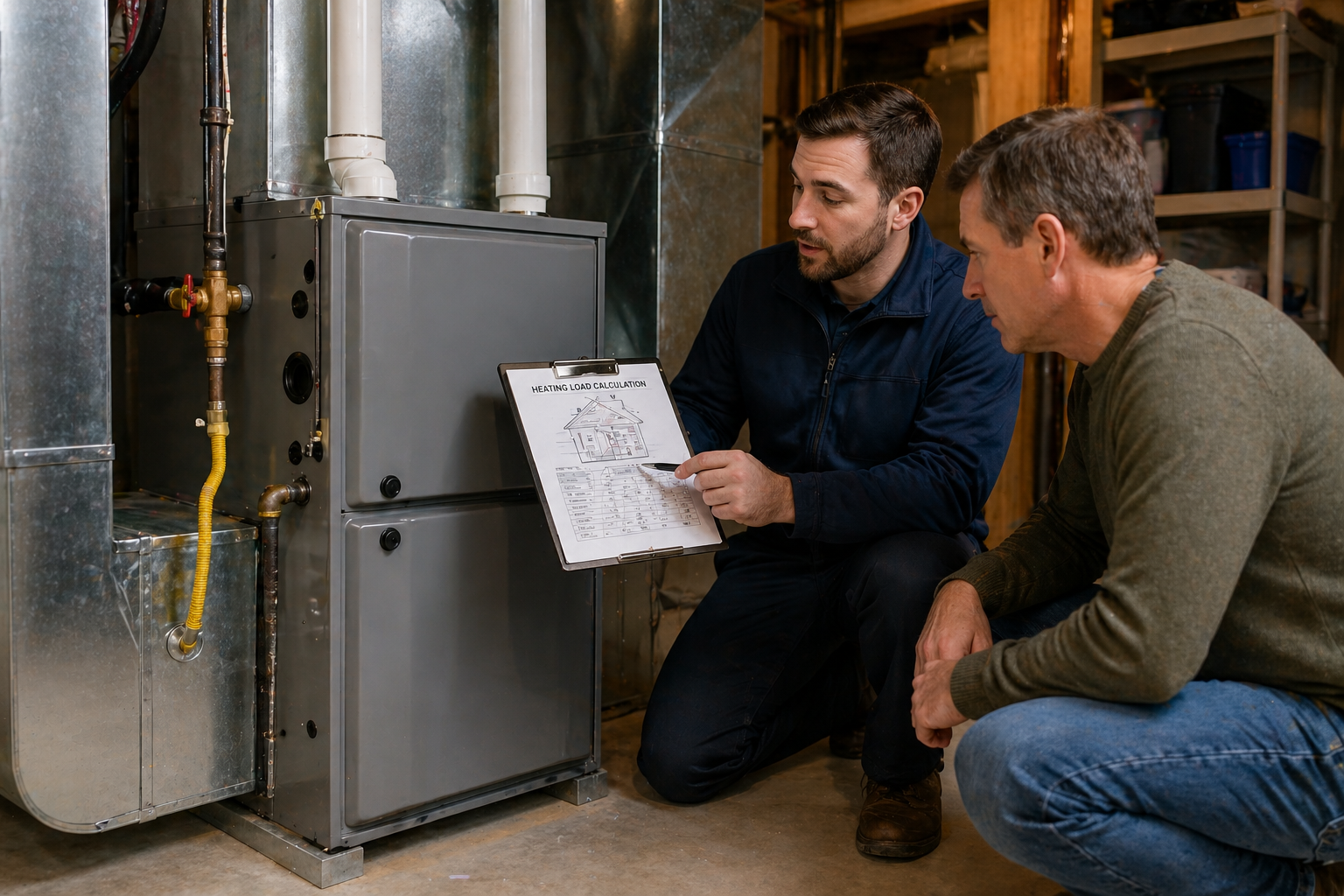
The only way to guarantee a perfectly sized heating system is through an ACCA-approved Manual J load calculation. This rigorous assessment is the gold standard used by reputable HVAC contractors to determine exact heating and cooling loads. The formula factors in local climate data, specific design temperatures for our area, and all the architectural variables of your home.
Relying strictly on square footage multipliers is a gamble that often leads to oversized equipment. A proper Manual J calculation typically takes an hour or two for a technician to complete during a residential assessment. The technician will measure rooms, check insulation depth, inspect ductwork, and note window orientations.
Most professional installers, including the team at Centerline Mechanical in Worcester County MA, include this calculation as a standard part of any replacement quote. Taking the time to run these numbers ensures your new system delivers optimal comfort and maximum energy efficiency for the next two decades.
Furnace Sizing FAQs
How big of a house can a 60,000 BTU furnace heat?
A 60,000 BTU unit can typically heat a home between 1,200 and 1,500 square feet in a cold climate like Zone 5A. The exact coverage depends heavily on how well the property is insulated and sealed against drafts. Modern homes with high-grade windows will stretch that capacity further than older, drafty properties.
What size furnace does a 2,000 sq ft house need?
A 2,000 square foot home in Worcester MA generally requires a furnace producing between 90,000 and 100,000 BTUs. This estimate assumes standard ceiling heights and average insulation quality for the region. Upgrading your attic insulation could potentially lower this requirement to an 80,000 BTU system.
How many square feet will an 80,000 BTU furnace heat?
An 80,000 BTU system is one of the most common residential sizes and heats roughly 1,600 to 2,000 square feet in our northern climate. It provides ample power to combat freezing winter temperatures as long as the ductwork is properly sealed. A Manual J calculation is still necessary to confirm this size matches your specific floor plan.
What is the $5,000 rule for furnace replacement?
The $5,000 rule helps homeowners decide whether to repair an aging system or invest in a new one. You multiply the age of your current equipment by the estimated repair cost, and if the total exceeds $5,000, replacement is the smarter financial choice. This calculation helps prevent sinking money into a failing unit that will need replacing soon anyway.
What size furnace do I need for a 3,000 square foot house?
Larger properties around 3,000 square feet in a heating-dominated climate need substantial power, typically between 135,000 and 150,000 BTUs. Homes this size often benefit from a zoned heating approach using multiple smaller units rather than one massive central system. Zoning provides better temperature control across different floors and reduces overall energy waste.
What size high efficiency furnace do I need?
High efficiency models rated at 95% AFUE or higher convert almost all their input fuel into usable heat. Because they waste very little energy through exhaust, you can often buy a unit with a lower input rating than a standard 80% efficiency model. A professional installer will adjust your target BTU input based on the specific AFUE rating of the model you select.